




CHANGER Toolkit
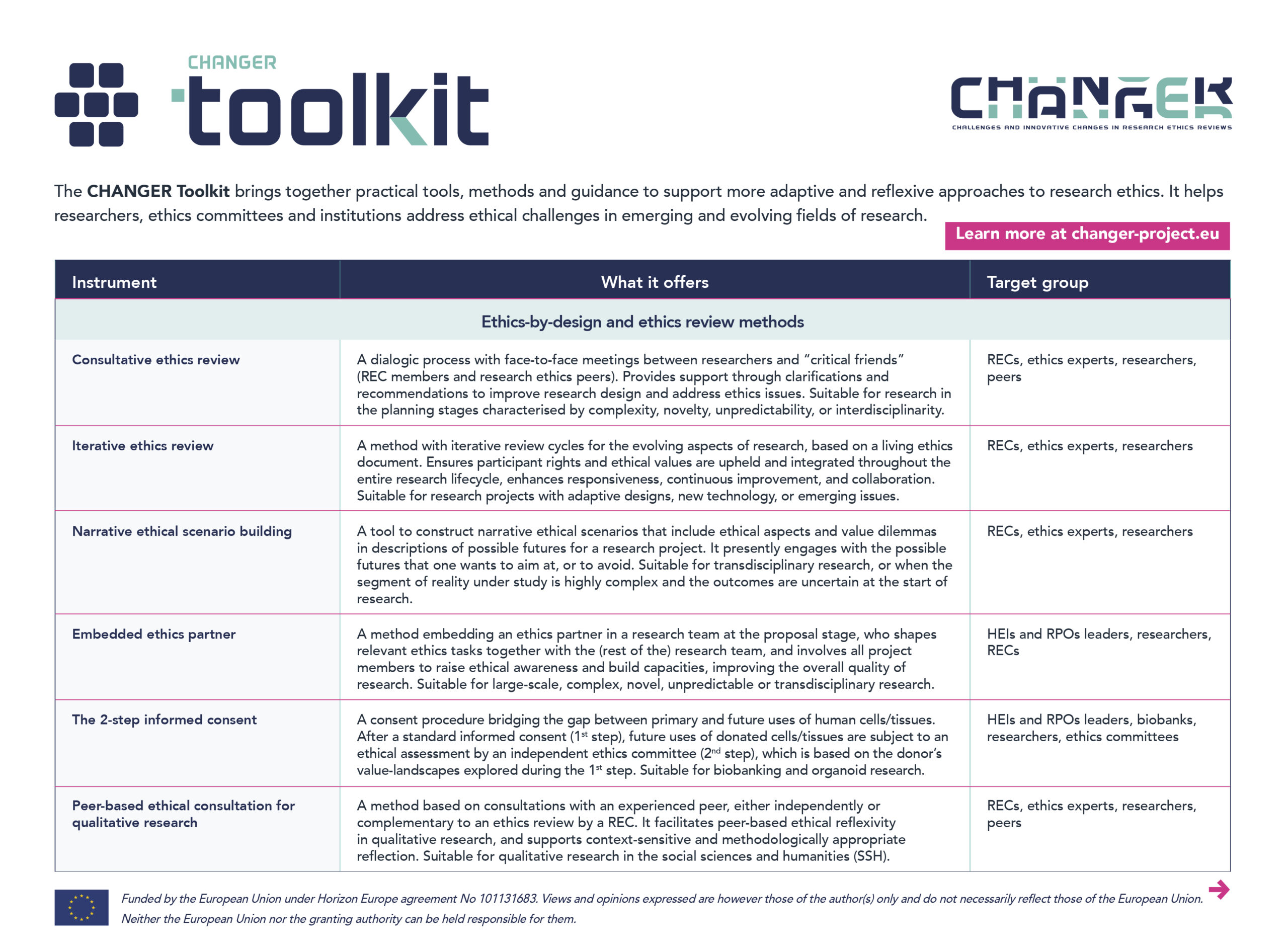
The CHANGER Toolkit brings together practical tools, methods and guidance to support more adaptive and reflexive approaches to research ethics. It helps researchers, ethics committees and institutions address ethical challenges in emerging and evolving fields of research.

| Instrument | What it offers | Target group |
| Ethics-by-design and ethics review methods | ||
| Consultative ethics review | A dialogic process with face-to-face meetings between researchers and “critical friends” (REC members and research ethics peers). Provides support through clarifications and recommendations to improve research design and address ethics issues. Suitable for research in the planning stages characterised by complexity, novelty, unpredictability, or interdisciplinarity. | RECs, ethics experts, researchers, peers |
| Iterative ethics review | A method with iterative review cycles for the evolving aspects of research, based on a living ethics document. Ensures participant rights and ethical values are upheld and integrated throughout the entire research lifecycle, enhances responsiveness, continuous improvement, and collaboration. Suitable for research projects with adaptive designs, new technology, or emerging issues. | RECs, ethics experts, researchers |
| Narrative ethical scenario building | A tool to construct narrative ethical scenarios that include ethical aspects and value dilemmas in descriptions of possible futures for a research project. It presently engages with the possible futures that one wants to aim at, or to avoid. Suitable for transdisciplinary research, or when the segment of reality under study is highly complex and the outcomes are uncertain at the start of research. | RECs, ethics experts, researchers |
| Embedded ethics partner | A method embedding an ethics partner in a research team at the proposal stage, who shapes relevant ethics tasks together with the (rest of the) research team, and involves all project members to raise ethical awareness and build capacities, improving the overall quality of research. Suitable for large-scale, complex, novel, unpredictable or transdisciplinary research. | HEIs and RPOs leaders, researchers, RECs |
| The 2-step informed consent | A consent procedure bridging the gap between primary and future uses of human cells/tissues. After a standard informed consent (1st step), future uses of donated cells/tissues are subject to an ethical assessment by an independent ethics committee (2nd step), which is based on the donor’s value-landscapes explored during the 1st step. Suitable for biobanking and organoid research. | HEIs and RPOs leaders, biobanks, researchers, ethics committees |
| Peer-based ethical consultation for qualitative research | A method based on consultations with an experienced peer, either independently or complementary to an ethics review by a REC. It facilitates peer-based ethical reflexivity in qualitative research, and supports context-sensitive and methodologically appropriate reflection. Suitable for qualitative research in the social sciences and humanities (SSH). | RECs, ethics experts, researchers, peers |
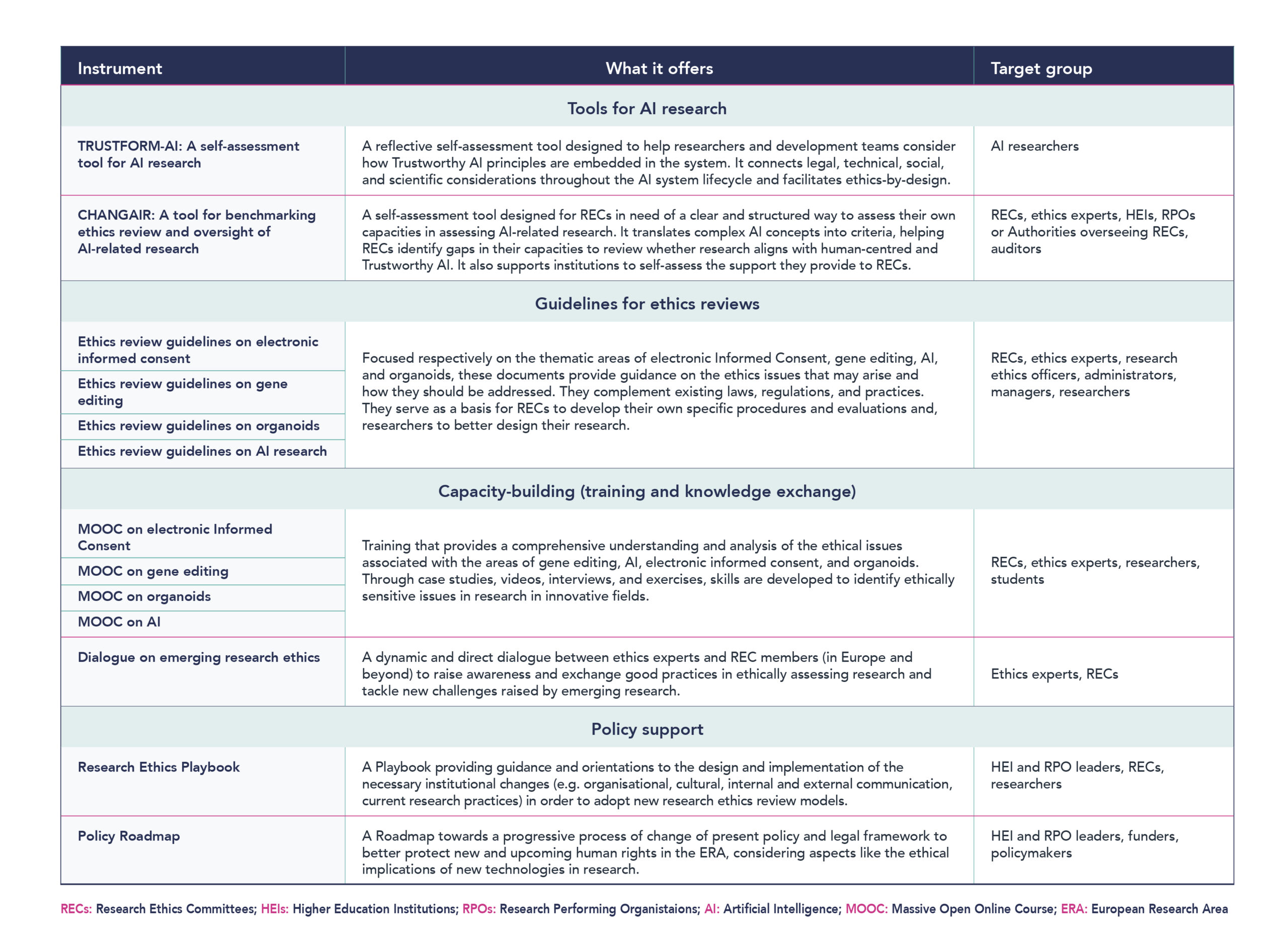
| Tools for AI research | ||
| TRUSTFORM-AI: A self-assessment tool for AI research | A reflective self-assessment tool designed to help researchers and development teams consider how Trustworthy AI principles are embedded in the system. It connects legal, technical, social, and scientific considerations throughout the AI system lifecycle and facilitates ethics-by-design. | AI researchers |
| CHANGAIR: A tool for benchmarking ethics review and oversight of AI-related research | A self-assessment tool designed for RECs in need of a clear and structured way to assess their own capacities in assessing AI-related research. It translates complex AI concepts into criteria, helping RECs identify gaps in their capacities to review whether research aligns with human-centred and Trustworthy AI. It also supports institutions to self-assess the support they provide to RECs. | RECs, ethics experts, HEIs, RPOs or Authorities overseeing RECs, auditors |
| Guidelines for ethics reviews | ||
| Ethics review guidelines on electronic informed consent | Focused respectively on the thematic areas of electronic Informed Consent, gene editing, AI, and organoids, these documents provide guidance on the ethics issues that may arise and how they should be addressed. They complement existing laws, regulations, and practices. They serve as a basis for RECs to develop their own specific procedures and evaluations and, researchers to better design their research. | RECs, ethics experts, research ethics officers, administrators, managers, researchers |
| Ethics review guidelines on gene editing | ||
| Ethics review guidelines on organoids | ||
| Ethics review guidelines on AI research | ||
| Capacity-building (training and knowledge exchange) | ||
| MOOC on electronic Informed Consent | Training that provides a comprehensive understanding and analysis of the ethical issues associated with the areas of gene editing, AI, electronic informed consent, and organoids. Through case studies, videos, interviews, and exercises, skills are developed to identify ethically sensitive issues in research in innovative fields. | RECs, ethics experts, researchers, students |
| MOOC on gene editing | ||
| MOOC on organoids | ||
| MOOC on AI | ||
| Dialogue on emerging research ethics | A dynamic and direct dialogue between ethics experts and REC members (in Europe and beyond) to raise awareness and exchange good practices in ethically assessing research and tackle new challenges raised by emerging research. | Ethics experts, RECs |
| Policy support | ||
| Research Ethics Playbook | A Playbook providing guidance and orientations to the design and implementation of the necessary institutional changes (e.g. organisational, cultural, internal and external communication, current research practices) in order to adopt new research ethics review models. | HEI and RPO leaders, RECs, researchers |
| Policy Roadmap | A Roadmap towards a progressive process of change of present policy and legal framework to better protect new and upcoming human rights in the ERA, considering aspects like the ethical implications of new technologies in research. | HEI and RPO leaders, funders, policymakers |
RECs: Research Ethics Committees; HEIs: Higher Education Institutions; RPOs: Research Performing Organistaions; AI: Artificial Intelligence; MOOC: Massive Open Online Course; ERA: European Research Area
Download below the CHANGER Toolkit table: